Geological study: Earth's magnetic poles may flip more frequently than previously thought
An international research team has discovered that in the Earth's geological past, magnetic poles could reverse every 90,000 years.
 🧠AI Analysis
Photo: UNIAN
Key points
- Magnetic poles may flip every 90,000 years
- Study based on limestone analysis in China
- Polarity shifts may be linked to tectonic processes
- Field weakening can impact the ozone layer
New insights into the planet's magnetic history
An international group of scientists led by the Chinese Academy of Sciences has published findings based on the study of limestone deposits near the city of Liuzhou. Analysis of samples spanning 3.75 million years allowed for the reconstruction of 29 magnetic polarity reversals.
Data indicates that the frequency of these events was not constant. While initially, poles shifted fewer than five times per million years, the frequency later increased to approximately 11 times per million years. This suggests that the Earth's magnetic poles could have swapped positions roughly every 90,000 years.
Links to supercontinent formation
Researchers hypothesize that the acceleration of magnetic inversions might have been triggered by the formation of the supercontinent Pangea. The subduction of oceanic crust fragments into the mantle likely altered heat dissipation from the Earth's core, destabilizing the magnetic field. The study also notes that the weakening of the magnetic field during these periods could have contributed to the depletion of the ozone layer and increased ultraviolet radiation on the planet's surface.
Source UNIAN — unian.ua/science/pivnichniy-polyus-zemli-mozhe-stati-pivdennim-usog… ↗
Read next
 🛡️Security
Lithuania denies Russian accusations of using its airspace for drone attacks
The Lithuanian Ministry of Foreign Affairs has officially refuted Russian claims regarding the country's involvement in a drone incident in the Kaliningrad region.
 🎭Culture & Sport
Kitchen Trends: How to Optimize Space in a Modern Home
Interior designers suggest moving away from bulky dining tables in favor of compact, cafe-style solutions.
 🛡️Security
Explosions and smoke reported in Russia's Krasnodar following drone attack
Krasnodar experienced a drone attack on the night of November 22, resulting in explosions and temporary flight restrictions.
 🇺🇦Ukraine
Donald Trump comments on the departure of press secretary Caroline Leavitt
President Donald Trump expressed his regret over the resignation of White House press secretary Caroline Leavitt, who chose to focus on her family.
 🎓Education
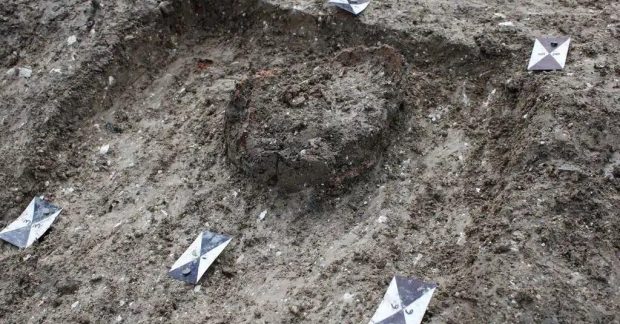
Archaeological discovery in Britain: unique Roman-era infant burial
During excavations in Buckinghamshire, archaeologists discovered a rare infant burial in a ceramic vessel, dating back to the 3rd-4th centuries AD.
 🎭Culture & Sport
Hair Care Secrets: Japanese Methods for Health and Shine
Experts have revealed the features of the Japanese approach to hair care, which focuses on scalp health and gentle cleansing.